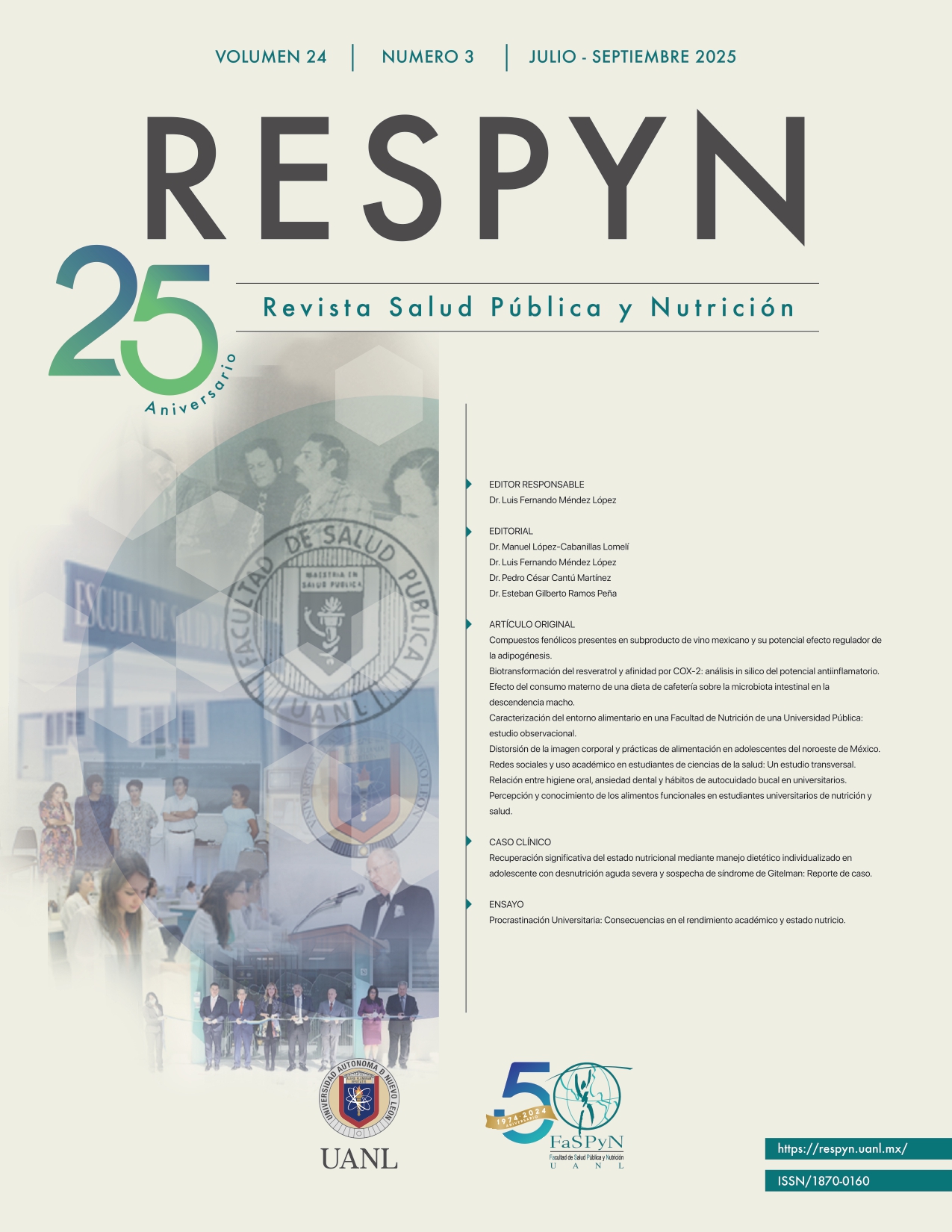
Significant recovery of nutritional status through individualized dietary management in an adolescent with severe acute malnutrition and suspected Gitelman syndrome: case report
DOI:
https://doi.org/10.29105/respyn24.3-865Keywords:
Terapia Dietética. Tubulopatías. Malnutrición.Abstract
Introduction: Pediatric malnutrition is associated with growth delay and increased morbidity. Likewise, hereditary tubulopathies, often underdiagnosed due to their nonspecific presentation, are frequently accompanied by malnutrition as a relevant manifestation. We present the case of an adolescent with severe acute malnutrition and suspected tubulopathy, in whom individualized dietary intervention led to a significant recovery of nutritional status. Case presentation: A 13-year-old female with a history of intellectual disability and chronic follicular gastritis was admitted due to dehydration, postprandial abdominal pain, early satiety, severe acute malnutrition (body mass index [BMI] 13.5 kg/m², mid-upper arm circumference [MUAC] 18.5 cm), hypokaluria, hypernatriuria, and normal chloruria (suggesting possible diagnosis of Gitelman syndrome). An individualized hypoallergenic diet, rich in potassium and magnesium (2,300 mg and 240 mg), and hypercaloric/hyperproteic (50 kcal/kg and 2 g/kg of protein) was prescribed. After Gitelman syndrome was ruled out, electrolyte supplementation was suspended and the dietary plan was maintained to address malnutrition. After 11 months of follow-up with comprehensive nutritional intervention, the patient achieved a total weight gain of 15.3 kg and a significant recovery of nutritional status. Conclusion: The recovery of nutritional status achieved through individualized dietary intervention highlights the importance of early nutritional management in pediatric patients with suspected tubulopathies. This case underscores the need to strengthen comprehensive diagnostic strategies integrating clinical, biochemical, and genetic analyses to optimize the management and follow-up of malnutrition associated with these conditions.
Downloads
References
Blanchard, A., Courand, P.-Y., Livrozet, M., & Vargas-Poussou, R. (2020). Bartter–Gitelman syndromes [Les syndromes de Bartter–Gitelman]. Néphrologie & Thérapeutique, 16(4), 233-243. https://doi.org/10.1016/j.nephro.2020.06.001 DOI: https://doi.org/10.1016/j.nephro.2020.06.001
Blázquez Gómez, C. J., Gil-Peña, H., Ordóñez Álvarez, F. A., & Santos Rodríguez, F. (2021). Evolución de tubulopatías renales primarias diagnosticadas en edad pediátrica. Nefrología, 41(2), 182–190. https://www.revistanefrologia.com/es-pdf-S0211699520301697 DOI: https://doi.org/10.1016/j.nefro.2020.07.015
Becue, C., Ceuleers, B., den Brinker, M., Somers, I., Ledeganck, K. J., Dotremont, H., & Trouet, D. (2022). Screening for an underlying tubulopathy in children with growth failure, simply maths?. Frontiers in Pediatrics, 10, 902252. https://doi.org/10.3389/fped.2022.902252 DOI: https://doi.org/10.3389/fped.2022.902252
Bettinelli, A., Rusconi, R., Ciarmatori, S., Righini, V., Zammarchi, E., Donati, M. A., Isimbaldi, C., Bevilacqua, M., Cesareo, L., Tedeschi, S., Garavaglia, R., & Casari, G. (1999). Gitelman disease associated with growth hormone deficiency, disturbances in vasopressin secretion and empty sella: A new hereditary renal tubular–pituitary syndrome? Pediatric Research, 46(2), 232-238. https://doi.org/10.1203/00006450-199908000-00017 DOI: https://doi.org/10.1203/00006450-199908000-00017
Bouma, S. (2017). Diagnosing pediatric malnutrition: Paradigm shifts of etiology‐related definitions and appraisal of the indicators. Nutrition in Clinical Practice, 32(1), 52–67. https://doi.org/10.1177/0884533616671861 DOI: https://doi.org/10.1177/0884533616671861
Caulfield, L. E., de Onis, M., Blössner, M., & Black, R. E. (2004). Undernutrition as an underlying cause of child deaths associated with diarrhea, pneumonia, malaria, and measles. The American Journal of Clinical Nutrition, 80(1), 193–198. https://doi.org/10.1093/ajcn/80.1.193 DOI: https://doi.org/10.1093/ajcn/80.1.193
Ceballos-Rodríguez, R., García-Ortiz, J. E., & Morán-Martínez, J. (2019). Síndrome de Fanconi-Bickel: reporte de un caso. Revista Médica del Hospital General de México, 82(3), 155–160. https://doi.org/10.24875/GMM.19004919
Da Silva, J. S., Seres, D. S., Sabino, K., Adams, S. C., Berdahl, G. J., Citty, S. W., & Parenteral Nutrition Safety and Clinical Practice Committees, American Society for Parenteral and Enteral Nutrition. (2020). ASPEN consensus recommendations for refeeding syndrome. Nutrition in Clinical Practice, 35(2), 178–195. https://doi.org/10.1002/ncp.10474 DOI: https://doi.org/10.1002/ncp.10474
Dipasquale, V., Cucinotta, U., & Romano, C. (2020). Acute malnutrition in children: Pathophysiology, clinical effects and treatment. Nutrients, 12(8), 2413. https://doi.org/10.3390/nu12082413 DOI: https://doi.org/10.3390/nu12082413
Francini, F., Gobbi, L., Ravarotto, V., Toniazzo, S., Nalesso, F., Spinella, P., & Calò, L. A. (2021). The dietary approach to the treatment of the rare genetic tubulopathies Gitelman’s and Bartter’s syndromes. Nutrients, 13(9), 2960. https://doi.org/10.3390/nu13092960 DOI: https://doi.org/10.3390/nu13092960
García-Pose, A., & Espinosa, L. (2008). Nefrología: Tubulopatías. Anales de Pediatría Continuada, 6(5), 249–257. https://doi.org/10.1016/S1696-2818(08)74877-7 DOI: https://doi.org/10.1016/S1696-2818(08)74877-7
Gilligan, C., Cunningham, J., [otros autores si los hay]. (2023). A Case of Gitelman Syndrome Complicated by Growth Hormone Deficiency. Medicine (Baltimore). https://pubmed.ncbi.nlm.nih.gov/40663076/
Hayashi, T., Takahashi, S., & Mizuno, Y.; et al. (1999). Recombinant human growth hormone and Gitelman's syndrome. American Journal of Kidney Diseases, 34(5), 944-950. https://doi.org/10.1016/S0272-6386(99)70233-7 DOI: https://doi.org/10.1016/S0272-6386(99)70233-7
Holliday, M. A., & Segar, W. E. (1957). The maintenance need for water in parenteral fluid therapy. Pediatrics, 19(5), 823–832. https://pubmed.ncbi.nlm.nih.gov/13431307/ DOI: https://doi.org/10.1542/peds.19.5.823
Washington, J., & Rathbun, J. M. (1984). Team management of failure to thrive. Journal of the American Dietetic Association, 84(7), 810–815. https://pubmed.ncbi.nlm.nih.gov/6736509/ DOI: https://doi.org/10.1016/S0002-8223(21)08250-X
Koletzko, B., Bhatia, J., Bhutta, Z. A., Cooper, P., Makrides, M., Uauy, R., & Wang, W. (Eds.). (2015). Pediatric nutrition in practice (2nd ed.). Karger Medical and Scientific Publishers. DOI: https://doi.org/10.1159/isbn.978-3-318-02691-7
Méndez-Durán, A., Méndez-Bueno, J. F., Tapia-Yáñez, T., Muñoz de la Torre, A., & Paniagua, R. (2007). Epidemiología de la insuficiencia renal crónica en México. Diálisis y Trasplante, 28(1), 7–11. https://doi.org/10.1016/S1886-2845(07)74642-5 DOI: https://doi.org/10.1016/S1886-2845(10)70004-7
Sasmita, G. Y., Shen, Y.-L., Tsai, Y.-C., et al. (2019). Gitelman syndrome combined with growth hormone deficiency: Three cases report. BMC Nephrology. https://pubmed.ncbi.nlm.nih.gov/31577716/
Schofield, W. N. (1985). Predicting basal metabolic rate, new standards and review of previous work. Human Nutrition: Clinical Nutrition, 39, 5–41. https://pubmed.ncbi.nlm.nih.gov/4044297/
Shinde, S., Wang, D., Moulton, G. E., & Fawzi, W. W. (2022). School‐based health and nutrition interventions addressing double burden of malnutrition and educational outcomes of adolescents in low‐ and middle‐income countries: A systematic review. Maternal & Child Nutrition, e13437. https://doi.org/10.1111/mcn.13437 DOI: https://doi.org/10.1111/mcn.13437
Swan, W. I., Vivanti, A., Hakel-Smith, N. A., Hotson, B., Orrevall, Y., Trostler, N., & Papoutsakis, C. (2017). Nutrition care process and model update: Toward realizing people-centered care and outcomes management. Journal of the Academy of Nutrition and Dietetics, 117(12), 2003–2014. https://doi.org/10.1016/j.jand.2017.07.015 DOI: https://doi.org/10.1016/j.jand.2017.07.015
Downloads
Published
How to Cite
Issue
Section
License
Copyright (c) 2025 Adriana Lucía Garza Ramírez, María Alejandra Sánchez Peña , Sofía Cuéllar Robles

This work is licensed under a Creative Commons Attribution 4.0 International License.
The rights of the work belong to the author or authors, however, by sending it for publication in the Public Health and Nutrition Magazine of the Faculty of Public Health and Nutrition of the Autonomous University of Nuevo León, they grant the right for its first publication in between electronic, and possibly, in print to the Public Health and Nutrition Magazine. The license used is the Creative Commons attribution, which allows third parties to use what is published whenever the authorship of the work is mentioned and the first publication that is in the Public Health and Nutrition Magazine. Likewise, the author or authors will take into account that it will not be allowed to send the publication to any other journal, regardless of the format. The authors will be able to make other independent and additional contractual agreements for the non-exclusive distribution of the version of the article published in the Public Health and Nutrition Magazine (e.g., institutional repository or publication in a book) provided they clearly state that The work was published for the first time in the Public Health Magazine, Magazine of the Faculty of Public Health and Nutrition of the Autonomous University of Nuevo León.